
Teeth Whitening Adelaide: What It Fixes, What It Cannot
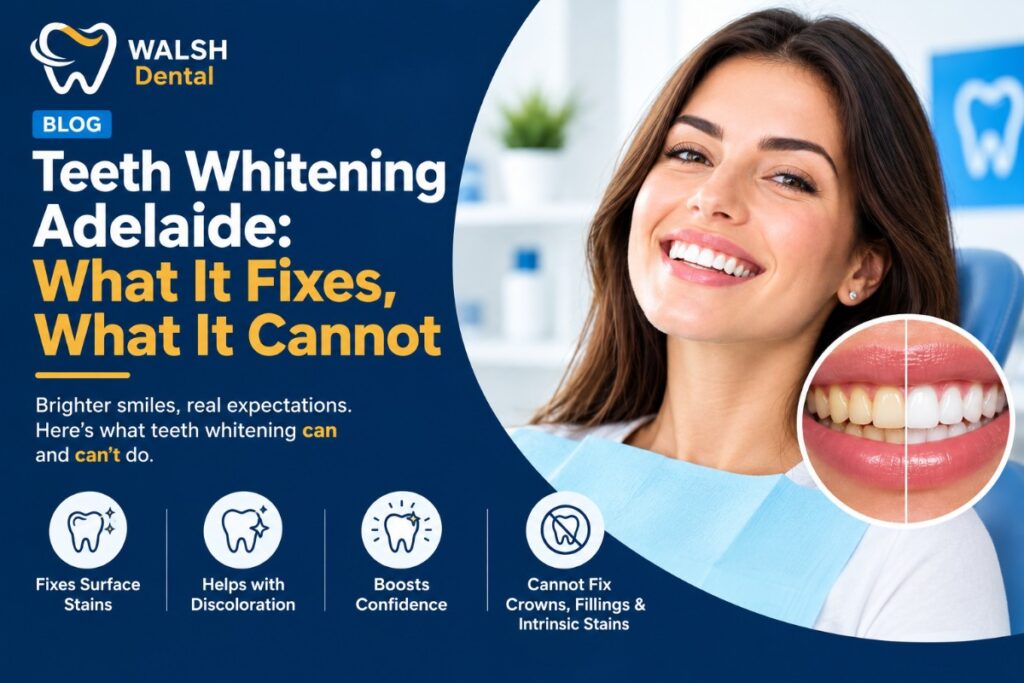
Teeth Whitening Adelaide: What It Fixes, What It Cannot If your smile has lost some of its brightness, professional whitening may be a simple way to bring back its natural sparkle. For many people, it can make a noticeable difference. However, whitening does not work on every type of tooth discolouration. Understanding the cause of the staining first can help you choose the right treatment and avoid unrealistic expectations. At Walsh Dental, we often see patients who expect whitening to remove every stain, mark, or dark spot on their teeth. While surface stains and some types of natural discolouration can respond very well to professional treatment, deeper or internal stains may need another approach. If you are considering teeth whitening Adelaide, knowing what the treatment can and cannot improve will help you make a more informed decision about your smile. How Does Teeth Whitening Actually Work? Professional teeth whitening uses a peroxide-based gel (usually hydrogen peroxide or carbamide peroxide) to break down stain molecules trapped in and on the enamel. The peroxide penetrates the tooth structure, oxidises the discoloured compounds, and lightens their appearance. There are two main approaches: In-chair whitening (such as Zoom Whitening): A stronger concentration gel is applied by a dentist and activated with light, delivering visible results in a single visit. Take-home whitening kits: Custom-fitted trays and a lower-strength gel are used over one to two weeks, offering a gradual, controlled result. Both methods work on the same principle, but they only work on certain types of discolouration, which is where most of the confusion starts. What Teeth Whitening Can Fix The good news is that whitening handles the most common causes of discoloured teeth very effectively. Surface stains from food and drink: Coffee, tea, red wine, curry, and dark sauces all leave pigment behind on enamel over time. These extrinsic stains sit on the surface and respond well to bleaching. Stains from smoking or tobacco: Nicotine and tar build up on enamel in a similar way to food stains, and whitening can lift much of this discolouration. Age-related yellowing: As enamel naturally thins with age, the yellower dentin layer underneath becomes more visible. Whitening can brighten this appearance significantly, even if it doesn’t reverse the underlying enamel thinning. General dullness from diet and lifestyle: Everyday wear and tear from your diet, oral hygiene habits, and time can leave teeth looking duller than they used to be. This is one of the most reliably improved concerns with whitening. Mild to moderate discolouration before an event: If you want a brighter smile for a wedding, job interview, or photos, whitening is often the fastest, least invasive way to get noticeable results. What Teeth Whitening Cannot Fix This is the part most patients don’t hear about until they’re already in the chair. Some causes of discolouration simply don’t respond to bleaching, no matter how many sessions you do. Tetracycline stains: If antibiotics were taken during childhood tooth development (or by a mother during pregnancy), they can cause grey or brownish banding deep within the tooth structure. These stains are internal and structural, not surface-level, so standard whitening has little to no effect. White spots from fluorosis or enamel defects: Whitening evens out yellow and brown tones, but it can’t blend away white spots caused by fluorosis or developmental enamel defects. In some cases, whitening the surrounding enamel can actually make white spots more noticeable by contrast. Restorations: crowns, veneers, fillings, and bonding: Porcelain, composite, and ceramic materials don’t respond to peroxide gel the way natural enamel does. If you whiten your natural teeth, any existing crowns or fillings will stay the same shade, which can create a mismatched smile. This needs to be planned for before treatment. Dead or root-canal-treated teeth: A root-canal-treated or dead tooth can darken from the inside, making external whitening ineffective. Internal (non-vital) whitening treats the discolouration from inside the tooth and helps restore its natural appearance. Enamel wear, chips, and structural damage: Whitening changes colour, not shape or structure. Cracks, chips, or worn edges need restorative treatment, not a bleaching gel. Gum-related discolouration: Shadows caused by receding gums or thinning enamel near the gumline are structural issues, not staining, and whitening won’t resolve them. In-Chair Whitening vs At-Home Kits vs Over-the-Counter Products Not all whitening is equal, and this matters as much as understanding what whitening can treat. In-chair professional whitening offers the fastest, most dramatic, and most predictable results because it’s supervised, uses higher-strength gel, and protects your gums during treatment. Dentist-supplied take-home kits use custom trays for an even, comfortable fit, giving controlled results over a slightly longer timeframe. Over-the-counter strips and pens use much lower concentrations and generic, one-size-fits-all trays. Results are usually modest, uneven, and slower, and there’s a higher risk of gum irritation from poor-fitting applicators. Seeing a qualified whitening dentist Adelaide patients trust means your treatment is tailored to your specific staining, your enamel condition, and your sensitivity levels rather than a generic approach that may not suit your teeth at all. Not sure whether teeth whitening can fix your tooth discoloration? CALL: 08 8331 0436 BOOK AN APPOINTMENT What to Do When Whitening Won’t Work If your discolouration falls into the “cannot fix” category, that doesn’t mean you’re out of options. It just means whitening isn’t the right tool. Depending on the cause, alternatives include: Porcelain veneers to mask tetracycline stains, white spots, or uneven enamel Composite bonding for smaller, localised discolouration or chips Crowns where structural damage or heavy staining is combined with weakened tooth structure Internal (non-vital) whitening specifically for root-canal-treated teeth A proper assessment is the only way to know which category your teeth fall into, which is why a consultation matters more than guessing based on what worked for a friend or a product you saw online. Is Teeth Whitening Safe? For most healthy adults, professional whitening is safe when supervised by a dentist. Temporary tooth sensitivity or mild gum irritation are the most common side effects, and they usually settle within